When you think about lava, immense heat and pure destruction usually come to mind. Although, lava is also a driving force of creation. Since our planet’s origins, lava has continually helped to reshape the surface with new and fertile lands. Read on for more details about what it’s like when exploring lava and what steps you can take to explore it yourself.

What is it Like to Explore Lava?
The crunching sound of molten rock echoes in your ears while the stench of burnt rubber courses through your nose. This is what you can expect when getting an up-close encounter with lava.
Since there are upwards of 1,350 potentially active volcanoes in the world, encounters with lava can vary based on where you are and how the landscape is in that area. For example, my adventure took place on the Big Island in Hawaii and required roughly four miles of hiking across the hardened black surface of dried lava rock. With wild flows during the time of eruption, there can be a lot of ups and downs when navigating your way across this kind of terrain.
It’s important to stay hydrated and have proper shoes when hiking distances over lava rock. The rock itself is like glass and can be very sharp so long pants are highly recommended. Little shards can break off with each step and fly into your socks the same way that loose sand does on a beach trail.
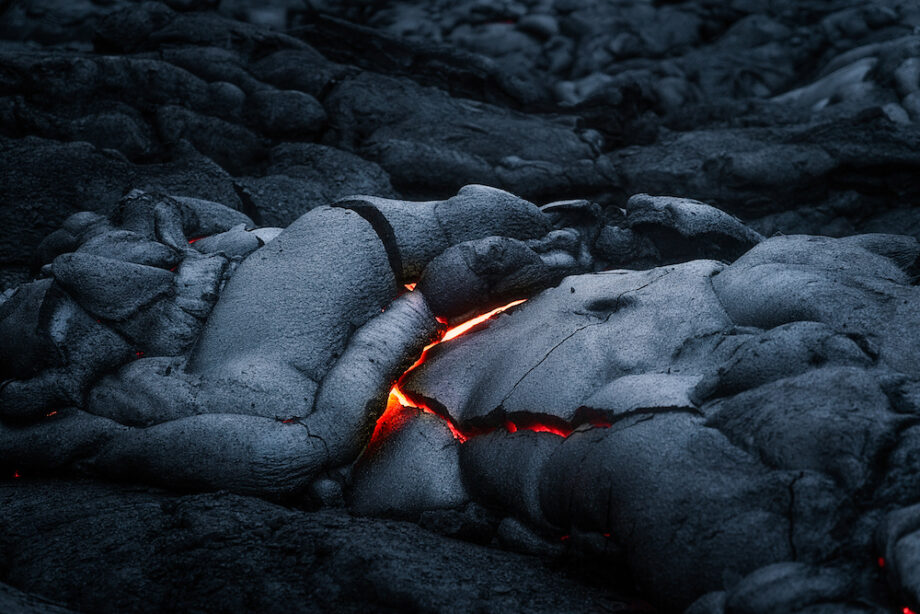
Once you get to the lava, you will experience a form of primitive earth that nothing else can really relate to. The power of lava can be felt immediately by the immense heat that radiates from it. The red glow of the lava can quickly fade to a light silver color as it rapidly cools once it touches the air. Scenes like this can provide some incredible photographic moments for those who love the chase. Although, it is also a great experience to keep for yourself.

Where to Explore Lava
As stated earlier, there are over 1,350 active volcanoes on the planet. Of those, roughly 48 are currently erupting. This means there are options to choose from, but it doesn’t necessarily mean to just go walk out and find them yourself.
Early in 2021, an eruption occurred in Iceland that brought a lot of attention and plenty of visitors to the area. Although, this event was guarded by law enforcement on the island to ensure people didn’t get hurt or injured.
Lava is very unpredictable and very unstable. I highly recommend against trying to go out solo to explore it. When I was in Hawaii, I made sure to hire trained professionals to guide us to the Kalapana flow. Even this comes with risks, but at least you will have people with you who know how to navigate the land.
Now that a little safety warning has been issued, here is a list of six places where you can safely view flowing lava.
Volcanoes National Park, Hawaii
Two of Hawaii’s flowing volcanoes are located inside this park. Unfortunately, in May of 2021, the U.S. Geological Survey announced a cease in one that has been continually flowing since 1983. Hopefully, future ones are likely to resume. Here you can see lava flowing into the ocean while also taking guided tours via land, sea, and air.

Mount Etna, Italy
Located in Sicily, this is Italy’s tallest and most active volcano. It is also highly accessible and can be reached by car, bus, bike, cable car, train, or foot. You may encounter slow-moving lava flows on your visit through many various fissures and vents at lower altitudes.
Pacaya, Guatemala
This volcano is almost a guarantee to see flowing lava since it has continuously erupted since 1965. It’s an easy one-hour journey and you can get right up next to the lava as it flows.
Villarica, Chile
Here you can take a guided tour to the top, or hop in a helicopter and see the pool from above. This isn’t an easy hike so be prepared to take on some steep terrain.

Erta Ale, Ethiopia
This volcano requires a harsh drive through heinous conditions while hiking three hours (usually in the dark at night) to the crater’s rim. Inside a pool of bubbling and glowing lava can be seen that has possibly been brewing since as early as 1906. Due to its location in a volatile spot in Ethiopia, the U.S. State Department cautions against traveling to certain parts of the country.
Mount Nyiragongo, Democratic Republic of the Congo
This volcano requires a 4-7 hour hike to the top. It is located in Virguna National Park and contains the world’s largest lava lake at its center. Pack warm clothes because it can get quite cold at the top. Once again located in a hostile territory, it is advised to reconsider travel to this region.
How to Explore Lava
The top tool for finding and exploring lava is research. Find out where lava is flowing and what the best and safest way to get to it is. I am a glutton for research, so I tend to continually check and recheck my information. Again, lava is very unpredictable and can quickly change on a whim. Be ready to adjust or cancel your plans as needed. Safety should always be the top priority when planning a lava trip.
Safety Precautions
The best thing you can do when exploring lava is trust professionals to help guide you. There are a lot of risk factors that you might not account for when hiking to lava. This includes toxic gasses, weak spots that can break away to an active flow underneath, and change in weather conditions that can turn rain into a super-heated steam vent. Lava is amazing to experience firsthand when properly prepared, but it is also unforgiving and should never be underestimated.
Article and Photos by Michael Castaneda
Michael Castaneda is an award winning adventure/travel photographer based in Los Angeles, California. His passion to capture raw emotion in nature is what drives him to continually push himself in both photography and exploration.